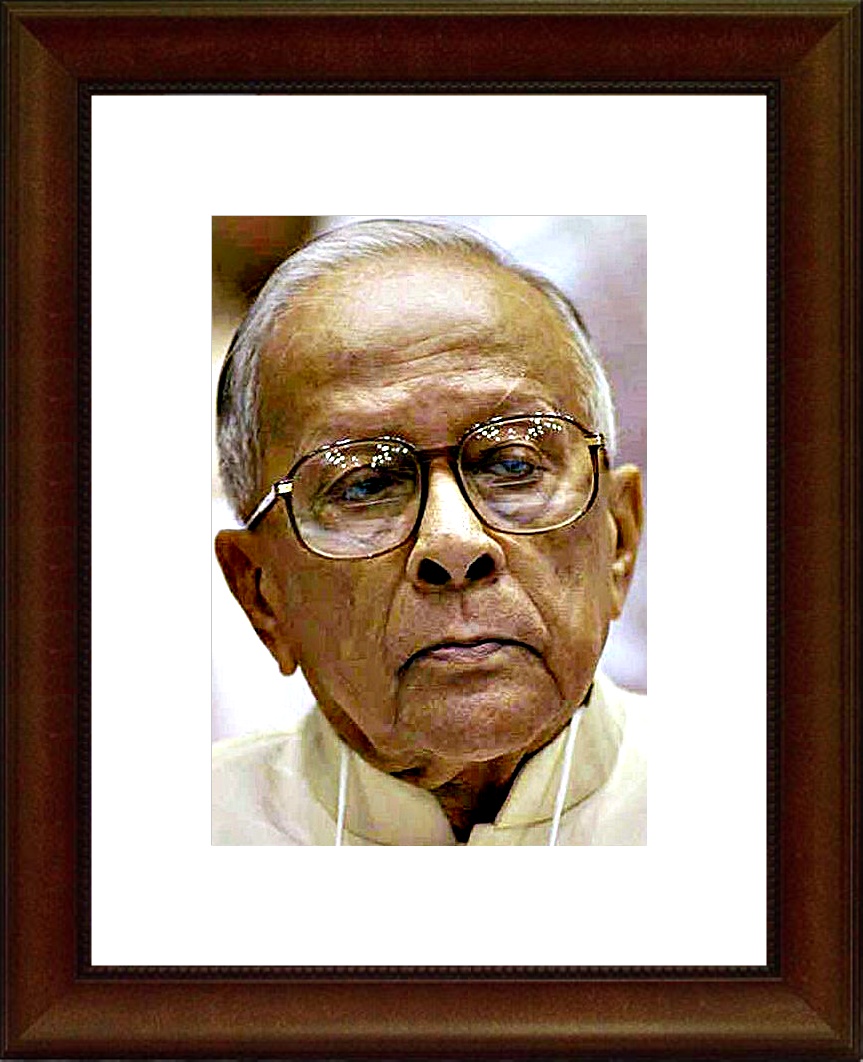
Jyoti Basu
(1914–2010)
Utsa Patnaik
JYOTI Basu’s life and political work spanned an astonishingly long era. His very early childhood was spent in Calcutta during the First World War, and by the time he was a college student, first at St Xavier’s and later Presidency College, both India and the world were in the throes of the Great Depression. Jyoti Basu belonged to a well-to-do professional family and went to England, as did many others of his background at the time, to study to be a barrister. He spent four years, from 1935 to 1939, in a depression-ravagedEngland with fascism rising in Europe, and underwent a decisive intellectual transition, becoming a strong and lifelong adherent of Marxism with the resolve to enter the arena of political struggle. When he returned and joined the illegal Communist Party of India in 1940, war had already broken out in Europe and was to engulf the Asian theatre less than two years later. This was followed by the great Bengal Famine, the tumultuous years of Partition, communal riots and Independence.
BENGAL AFTER
INDEPENDENCE
The meteoric rise of the Left in Bengal and its consolidation, the repeated evidence of trust and confidence the masses of Bengal have reposed in the Left for over three decades, and Jyoti Basu’s role in it cannot be understood without some understanding of the situation of Bengal after Independence, in the 1950s and 1960s. It inherited a legacy of two centuries of colonial rule, an acute food problem, problems of refugee influx and resettlement, and above all, an unresolved agrarian question. It was the cadres of the Left movement which tackled these early problems decisively, working tirelessly among the masses, and later, with the formation of Left Front governments, tackled the agrarian question and improvement of mass welfare.
Today very few people have any knowledge of the extreme poverty and destitution to which the ordinary people in Bengal had been reduced by the time Independence came, least of all Bengal’s own bhadralok intellectuals whose unremitting ‘western gaze’ has meant their being hegemonised by false theories emanating from Northern universities. In fact many of these intellectuals are making comfortable positions for themselves in foreign universities by denigrating our national freedom movement in some form or the other. The people belonging to that generation in Bengal which is now in its mid-forties or less in age, have known nothing but Left rule since they began to be aware of politics at all. Therefore few commentators today have any understanding of the situation before that rule or the significance of the progress the people have made, even though there has been some predictable reversal in the neo-liberal era in the trend of progress. A brief recapitulation of the results of Bengal’s long subjugation and the legacy it inherited may not be out of place.
Bengal was the very first region of India to be colonised from 1765 onwards (this date is when the Company acquired the sovereign right of collecting taxes and began to rule). Bengal was initially the richest province of British India and the value of land tax collected under the 1793 Permanent Settlement was actually more than the total land tax collected within Britain in that period. Bengal was the revenue base from where British conquest extended over the whole of India, with the annexation of Punjab coming almost a century later in 1848. Bengal experienced a paradoxical type of ‘development’: it was systematically ripped off by Britain, which took away every year vast volumes of products, crops and textiles from peasants and artisans, essentially as tax, without any real payment. This was because a part of the taxes collected from these very same peasants and artisans were used to ‘buy’ their products by the Company, so in effect they were handing over these goods free, as that part of tax. Such systematic denuding of the province every year over a long period continuously depressed the incomes and purchasing power of the masses, and one important index of impoverishment was the steadily declining nutritional level of the population. At the same time, the zamindari system and the new educational system created a class of urbanised rich rentiers and rising professionals who were, by upbringing and education, completely subservient to imperial interests. Calcutta grew ever larger as the port city through which unpaid exports were sent out of the country, and Lancashire textiles were imported to the detriment of Bengal’s spinners and weavers. All of this provided employment to traders, transporters and port coolies so that the proportion of workers in tertiary or service sector activities went up while the proportion working in manufacturing fell, and this remained true even with jute and cotton textile mills coming up.
The inter-war depression affected rural people badly as crop prices declined, and so did employment. Between 1911 and 1947, per capita food grains availability fell by 38 per cent in undivided Bengal, mainly because there was absolute decline in rice output as more land and resources went to the export crops the rulers wanted. In no other province was the situation so bad as to lead to an absolute fall in foodgrain output itself, although every other province saw a fall in per head grain output. Long-term impoverishment and lowered nutrition reduced the resistance of the population in Bengal and made it more vulnerable to the shock of the great famine.
The history of colonised Bengal had begun with a massive famine, the 1770 famine which killed an estimated one-third of the population; and it ended with another massive famine, the famine of 1943–44 which killed over 30 lakh persons and reduced five times that number to utter destitution. This was a famine created by the British government which placed the entire burden of financing Allied troops and air operations in the anti-Japan war, on India. But because Bengal was near the frontline, in practice the construction of barracks and airstrips, the maintenance and provisioning of the Allied troops and air force personnel, all took place in this eastern region, and it was the primary resources of this region which had to meet the vastly increased demand. Rs 3,800 crore was the extra expenditure burden put on the people during the war. The result was rapid food price inflation, a trebling of rice prices over only eighteen months, reducing the already undernourished rural poor to starvation. A war, whose cost a rich industrial Britainshould have met, was imposed on the people of Bengal, and the price they were made to pay was over thirty-one lakh lives. But all this does not alter the bhadralok intellectuals’ reverence for all things western, and we do not find to this day a single realistic economic analysis of the Bengal famine which places the blame where it belongs, on the deliberate policy pursued by the imperialists to put the burden of war finance on defenceless peasants and artisans of India in general and on Bengal in particular. No people have perhaps suffered as much as the people of Bengal have done under colonial rule, and none has been more badly served by its west-oriented liberal intellectuals – a proposition which remains true to this day. Those who have served the people well have been the political activists of the Communist movement including pre-eminently Jyoti Basu, who de-classed themselves from bhadralokservility by their adherence to and practice of Marxism.
As early as 1940, the Floud Commission (Land Revenue Commission, Bengal), in its report, had drawn attention to the fact that actual tenant cultivators could not be called labourers since they provided the cattle, ploughs, all inputs and their labour, but had to hand over half their gross produce including by-products as rent to the superior right holder. Though an Act was on the anvil to increase the share of the bargadar, nothing was done by the government led by Suhrawardy, who admitted to Jyoti Basu (as he points out in his memoirs) opposition from landed interests as the reason. After the war ended, the peasantry was prepared to wait no longer. A major agrarian agitation erupted, the Tebhaga movement, which demanded increase of the adhiyar–bargadar’s share to two-thirds of the crop. This was led by the Krishak Front of the Communist Party and was particularly active in the districts of Mymensingh, Barisal, Rangpur, Dinajpur, Jessore, Khulna and 24-Parganas. It succeeded to some extent in raising the tenant’s share of the produce. The movement of 1945–47 ended with Partition and the expectation of new measures from the government of Independent India and Pakistan.
FORMIDABLE TASK OF
RECONSTRUCTION
Quite apart from the actual loss of lives in the famine, by the time of Independence, Jyoti Basu’s Bengal was flooded with millions of peasants and artisans reduced to destitution, and millions of people poured in from the eastern part of Bengal after Partition. Nevertheless, the joy of political independence was irrepressible and the ultra-left slogan ‘Yeh azadi jhuti hai’ (‘This freedom is a lie’) found few takers. Reconstruction was a formidable task and without the work of the communists among the refugee population and the peasantry from whom they recruited new cadres, the successive Congress governments would have got nowhere. Although the West Bengal Estates Acquisition Act and the West Bengal Land Reforms Act had been passed by 1953 and 1955 respectively, implementation was slow and the festering unresolved agrarian problem meant that the vital agricultural sector remained in the doldrums. Shortages persisted, reaching crisis point in many years. The Food Movement of 1959 was a landmark agitation the Communist Party undertook. During the India–China conflict in 1962 large numbers of communists in India were jailed. Just as the imperialist war of 1914–18 in Europe had sorted out the communists from the social democrats, the China conflict was the catalyst which sorted out the left communists from the others and led to the split of the Communist Party of India (CPI), with Jyoti Basu being one of the founder-members of the new CPI-Marxist or CPI(M).
Soon afterwards the Party in Bengal had to contend with left adventurism and its violent cult of individual assassinations as the Naxalbari movement erupted. Large numbers of cadres lost their lives in this period with the ensuing repression. A split in a communist movement can be dangerous if either right revisionism on the one hand or left adventurism on the other, dominates and the militant middle, despite its correct line, cannot carry the majority of the members. While in Bengal the split and subsequent challenges were successfully handled, in Andhra Pradesh that had one of the strongest units of the CPI and with the proud legacy of the Telengana movement, decimation unfortunately resulted since large numbers of cadres went with either one or the other wrong trend. We see today again the rise of left adventurism and massacres of the innocent in the country, and while it faces inevitable defeat, before that occurs it will take a heavy toll in lives in the years to come.
UNPRECEDENTED
RECORD
While Jyoti Basu had served in the 1967–70 United Front government as well, the opportunity to make a real difference to the miserable situation of the people of Bengal came with the electoral victory of the Left Front and government formation by the coalition led by the CPI(M). The Left Front was repeatedly voted back to power by the people of Bengal in five successive elections after that, creating a world record of governance by communists within a federal parliamentary system, continuously for thirty-three years to date. What explains this unprecedented record which, it can be confidently stated, will never be broken in any other country? So anti-egalitarian is the economic and social structure in this country and so deeply rooted are the consequent structures of exploitation, that any sincere attempt to break this structure and to ameliorate the condition of the masses produces an overwhelming response from them. They gave their loyalty in abundance. The bhadralok in the cities and the rural elites continued in the main to pursue their conservative agenda, but the rural masses and the working classes were solidly behind the Left Front policies.
Bengal was the only state which had put a ceiling on land-holding from the very beginning in the legislation, abolishing zamindari in the West Bengal Estates Acquisition Act 1953, and nearly eight lakh acres of land was estimated to be surplus above ceiling. Between 1967 and 1970, with the first United Front government in which Jyoti Basu served, six lakh acres were distributed. Later amendments lowered the ceiling to 6.2 standard acres subject to a maximum of 17.3 standard acres for a nine-member family. After the Left Front assumed power, within a matter of three years between 1977 and 1980, nearly 10 lakh acres more ceiling surplus land was identified and three-quarters of this actually distributed within a few years. These implementation measures resulted in a larger area of ceiling-surplus land being distributed to the landless in West Bengal alone under Left Front rule by year 2000, than in several other states ofIndia combined to date. The revival of local democratic institutions and regular holding of panchayat elections were an integral part of the success in identifying and distributing ceiling-surplus land.
But the abolition of zamindari estates did not mean a complete land reform or end of rentiers, for zamindars were only the very top of an entire pyramid of intermediaries who performed no labour but lived on the surplus produced by the actual tillers, the majority of whom had no legal existence since they were unrecorded sharecroppers. They still had to hand over half their gross output to the jotedar even when they provided the livestock assets, working capital and labour. In Bihar, an attempt to register the actual cultivators had to be called off owing to landlord resistance. In Bengal, it was the vision and determination of Jyoti Basu and Harekrishna Konar, supported by Benoy Chaudhuri, which accounted for Operation Barga being carried through. Democratic participation was the very essence of this vision. As Harekrishna Konar had put it: "The indispensable condition for success in implementation is that the agricultural labourers, poor peasants, bataidars, who are really interested in land reform, must be roused; their initiative and courage will have to be developed so that they can stand up before the mighty power of the landlords and they must be asked to come forward in an organised way to help the government to implement."
The innovative strategy of taking administration to the villages, of involving local peasant organisations, panchayats and potential beneficiaries themselves, while using to the full the hitherto unutilised provisions of the law, worked. Particularly noteworthy is the use of the Indian Evidence Act, which permits oral evidence to be collected and presented to counter the written documents marshalled by the powerful landlords to deny legal rights in the courts to the sharecroppers on oral leases. All measures of land reform taken together, including distribution of homestead land, are estimated to have benefited nearly three-fifths of rural households. Jyoti Basu was acutely conscious that whatever had been achieved was only implementation of the democratic tasks of the bourgeoisie, which the latter itself was no longer capable of implementing, and very far from any completely egalitarian radical land redistribution which is part of the socialist agenda. He repeatedly pointed out that Bengal had to function within a legal system which safeguarded private property and a federal structure which restricted the measures which could be taken, that it was ‘not the republic of West Bengal’. Nevertheless with all caveats, what had been achieved was of tremendous significance in unleashing the confidence of the masses, enabling them to pull themselves up by their own efforts out of the mire of acute poverty and degradation.
The 1980s was the golden decade for India and particularly for Bengal, while the impetus was maintained well into the 1990s. Revival and vigorous functioning of local self-government institutions, combined with the fresh impetus to productivity in rural areas, led to Bengal surging ahead with the highest annual rate of foodgrain growth in the whole of India at 4.2 percent, compared to 2.5 percent average in other major states, over the period 1980–81 to 1998–99. This was crucial because, as Adam Smith had pointed out two centuries earlier, foodgrain prices determine all other primary prices through feedgrain and wage goods prices, and strongly impact labour-intensive manufacturing as well. Cheap food benefits the wage-paid working class, while the rural producers do not face large dips in prices when they raise output growth as long as a procurement system is in place. The state’s policy was expansionary in the 1980s with development expenditures growing at over eight percent annually, the highest rate in India.
There was a substantial positive trend growth in employment and incomes in both rural and urban Bengal, and the consumption expenditure data show that a larger decline took place in poverty in Bengal than in any other state. Of course, given the fact that the initial level of destitution, for the reasons analysed earlier, was much higher in Bengal than in most other regions, even this large order of improvement did not mean that all the problems of Bengal’s poor were solved. Medical services’ expansion to the required extent was thwarted by urban doctors with a dog-in-the-manger attitude – refusing to serve in rural areas, they nevertheless agitated against a plan to have a special health worker cadre with a shorter training period to deliver basic health care. They acted as a selfish professional group bent on maintaining their monopoly of skills, and they continue to constitute a highly conservative body at the national level, determined to exclude deprived social groups from their ranks. Despite these problems, one must appreciate the remarkable improvement in many important aspects of welfare that Bengal achieved.
National Sample Survey (NSS) data show that while in 1977–78, when the Left Front first assumed government, as much as 40 percent of the rural population in West Bengal could not spend enough to access even 1,800 calories energy, a very low level, fifteen years later, by 1993–94, this proportion had dropped to 17 percent, the largest reduction in extreme poverty anywhere in India over any period. Thus nearly a quarter of the population, constituting the very poor, had moved up in nutritional status. The significance of this may be judged by a comparison – in rural Gujarat, Maharashtra and Tamilnadu in 1993–94, as much as 36, 38 and 43 percent of the population respectively was unable to get even 1,800 calories per day. For a state which had come through a traumatic war-time famine and rural destitution, the large order of improvement in the situation of the poor in Bengal was a particularly important achievement. While in rural Bengal in 1977–78, as much as 67 percent of the population could not spend enough to obtain even 2,100 calories daily, fifteen years later this figure had dropped to 42 percent. Similarly there was a substantial decline in urban poverty as well, to 18 percent below an 1,800 calorie intake by 1993–94, much lower than in other urbanised states. After 1991 there was very sharp contraction in public spending by the central government and all states as neo-liberal policies were imposed on the people.West Bengal too was obliged to engage in public spending cuts as there was substantially reduced tax devolution from the central government and loans carried very high interest.
After the demolition of the Babri Masjid and rise of the Bharatiya Janata Party (BJP) elsewhere, a young Bengali intellectual was heard by this author to remark rather complacently that Bengalis were not communally minded, unlike people in other states, and right-wing communal forces could make little headway. This understanding however underestimates the strength of communal–chauvinist forces in Bengal, forgets communal riots during Partition, and does not give due credit to the unremitting struggle of the Left parties against communalism and in promoting progressive thinking, which marginalised these forces but which have never been fully defeated. It should be remembered that it was a Bengali who had provided leadership of the Hindu Mahasabha and set up the Jan Sangh, which was to reinvent itself as the Bharatiya Janata Party in the 1970s. It was Bengal which had spawned chauvinist organisations of the extreme right such as Anand Marg and Amra Bangali. After the assumption of government by the Left Front, no quarter was given to communal forces; the parties representing these forces and their violent behaviour was described by Jyoti Basu as ‘uncivilised’, an adjective the use of which was very typical of the man and which incensed the BJP leaders. Jyoti Basu took decisive action to smash every attempt – and they did occur – by right-wing forces to promote communal disharmony in Bengal. For over three decades while other areas of the country saw instigation of violence and communal rioting, including the capital Delhi which went up in flames in 1984, in Bengal minority communities have felt safe because Bengal has been made to remain free of communal violence. And that has been a major achievement of Jyoti Basu and the movement he led.
Jyoti Basu wrote his own epitaph thus – ‘There is nothing more valuable in life than the love of the people. We are always ready to sacrifice our lives for a greater cause.’ A most remarkable life, spent in struggle and service of the exploited. A life to be emulated, but impossible to emulate.
This article was published in Social Scientist, Issue 446–447, Volume 38, Numbers 7–8, July–August 2010. Sub-Headings have been added - Ed